
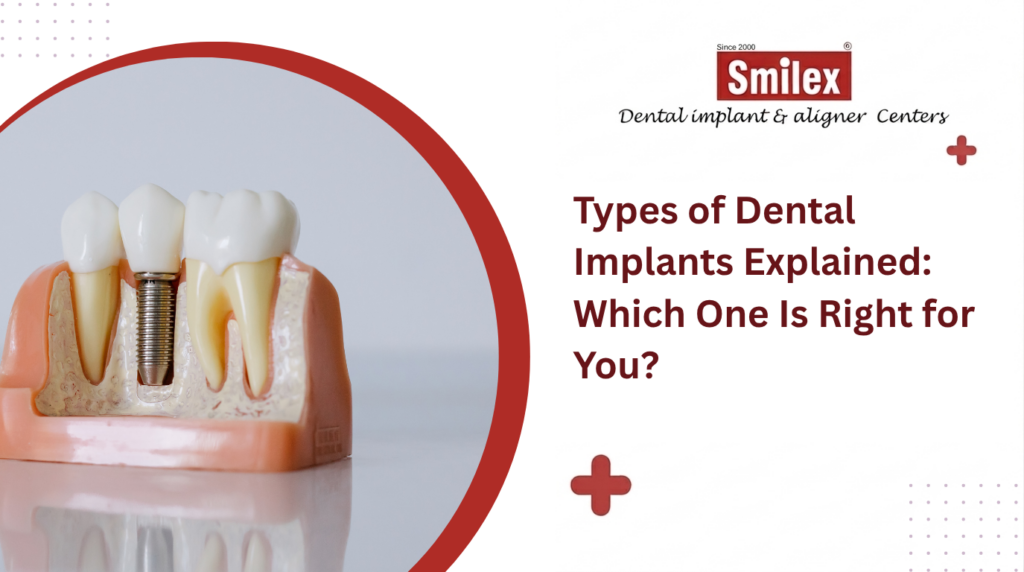
Choosing a dental implant solution depends on more than simply replacing a missing tooth. The number of missing teeth, jawbone condition, gum health, available space, and the type of restoration required can all influence which implant approach may be considered.There are different types and implant-supported solutions available, but not every option is suitable for every patient. Understanding the main categories can help you have a more informed discussion with your implant surgeon.At Smilex Dental Implant & Aligner Centers, implant treatment is planned according to each patient\’s individual dental condition and tooth replacement requirements.
What Are Dental Implants?
A dental implant is a small post, commonly made from biocompatible titanium, that is placed in the jawbone to replace the root portion of a missing tooth.Once healing and integration with the surrounding bone have taken place, the implant can provide support for a dental crown, bridge, denture, or full-arch restoration, depending on the treatment plan.
The most appropriate implant solution depends on factors such as:
- Number of missing teeth
- Location of the missing teeth
- Jawbone condition
- Gum health
- Available space
- Type of restoration required
- Individual treatment goals
This is why implant selection should be based on a professional clinical evaluation rather than on implant type alone.
Main Types of Dental Implants
Several implant categories and implant-supported solutions may be discussed during treatment planning. The most relevant option depends on the patient\’s anatomy and restoration requirements.
1. Endosteal Dental Implants
Endosteal implants are placed directly into the jawbone and are among the most commonly used implant designs.
They are generally considered when adequate bone support is available. After the implant integrates with the surrounding bone, it can support an individual crown, bridge, or other restoration.
Common use:
Replacing one or more missing teeth when the available bone and oral conditions are suitable.
Key consideration:
The patient\’s jawbone and gum health need to be evaluated before treatment.
For detailed information about the surgical stages involved in implant placement, see our dedicated dental implant procedure guide.
2. Subperiosteal Implants
Subperiosteal implants are positioned above the jawbone and underneath the gum tissue rather than being placed directly inside the bone.
They have historically been considered in situations where conventional implant placement may not be appropriate because of limited bone support. However, treatment options have evolved, and whether this approach is suitable depends on the patient\’s individual anatomy and the implant surgeon\’s assessment.
Common consideration:
Patients with specific bone-related limitations may require alternative treatment planning.
A consultation is necessary to determine which implant approach is clinically appropriate.
3. Mini Dental Implants
Mini dental implants are smaller in diameter than conventional implants.
Depending on the patient\’s situation, they may be considered for specific applications, including stabilizing certain removable dentures. Their smaller dimensions can make them useful in selected clinical situations, but they are not automatically an alternative to conventional implants for every patient.
Common consideration:
Limited space or particular denture-stabilization requirements.
The decision should be based on the patient\’s bone condition, restoration requirements, and long-term treatment goals.
4. Implant-Supported Bridges
An implant-supported bridge can be considered when several adjacent teeth are missing.
Instead of placing an individual implant for every missing tooth, strategically positioned implants can support a bridge containing multiple replacement teeth.
Common use:
Replacing several missing teeth in the same area.
The number and position of implants required depend on the patient\’s dental condition and the planned restoration.
5. All-on-4 Dental Implants
All-on-4 is a full-arch implant treatment concept in which a complete arch of replacement teeth is supported by four strategically positioned implants in suitable cases.
It is different from replacing individual missing teeth with separate implants and is generally considered for patients with extensive tooth loss.
Common use:
Full-arch tooth replacement in selected patients.
Because All-on-4 is a dedicated full-arch treatment, patients interested specifically in this option should review our detailed full-mouth dental implants / All-on-4 guide.
6. All-on-6 Dental Implants
All-on-6 is another full-arch treatment approach in which a complete arch of replacement teeth is supported by six implants in appropriately selected cases.
The suitability of four versus six implants depends on factors such as bone condition, anatomy, restoration requirements, and the implant surgeon\’s treatment plan.
Common use:
Full-arch restoration for patients with extensive tooth loss.
For a detailed discussion of full-arch treatment, link to the dedicated Full Mouth Dental Implants page rather than duplicating that information here.
Which Type of Dental Implant Is Right for You?
There is no single implant type that is right for every patient.
Your implant surgeon may consider:
Number of Missing Teeth
Replacing one missing tooth may require a different approach from replacing several adjacent teeth or an entire dental arch.
Jawbone Condition
The amount and quality of available bone can influence whether conventional implant placement is appropriate and whether additional treatment may be required.
Gum Health
Healthy gums and appropriate periodontal care are important considerations before and during implant treatment.
Type of Restoration
An implant may support an individual crown, bridge, removable denture, or full-arch restoration depending on the treatment plan.
Long-Term Treatment Goals
Your preferred outcome, functional requirements, oral health, and overall treatment objectives can also influence the recommended approach.
The final decision should therefore be made after a detailed clinical examination and appropriate diagnostic evaluation.
Dental Implant Types: A Simple Comparison
| Implant option | Common application | Main consideration |
| Endosteal implant | Single or multiple missing teeth | Requires suitable bone support |
| Subperiosteal implant | Selected cases with limited bone support | Less commonly used; case selection is important |
| Mini dental implant | Selected applications and denture stabilization | Not suitable for every restoration |
| Implant-supported bridge | Several adjacent missing teeth | Implant position and restoration design matter |
| All-on-4 | Full-arch tooth replacement | Requires comprehensive treatment planning |
| All-on-6 | Full-arch tooth replacement | Suitability depends on anatomy and restoration requirements |
This comparison provides only an overview. The appropriate treatment cannot be selected based on implant type alone.
What About Dental Implant Cost?
The cost of implant treatment can vary depending on the number of implants, implant system, restoration, jawbone condition, and any additional treatment required.
Because dental implant cost is a separate search intent, this article does not provide detailed pricing or duplicate cost tables.
For current Pune-specific pricing information, patients can visit the dedicated Dental Implant Cost in Pune page.
What About the Dental Implant Procedure?
The implant procedure involves clinical assessment, treatment planning, implant placement, healing, and restoration. However, the exact process varies between patients.
Rather than repeating a detailed surgical explanation on this page, read the dedicated Dental Implant Procedure guide for a complete patient-focused overview.
What About the Benefits of Dental Implants?
Different implant solutions can provide stable support for replacement teeth, but the benefits depend on the individual treatment and restoration.
Because benefits of dental implants is a separate topic within the Smilex content cluster, this page focuses specifically on understanding implant categories and their potential applications.
For a detailed discussion of appearance, stability, chewing function, jawbone support, and other advantages, visit our dedicated Benefits of Dental Implants guide.
How Should You Choose an Implant?
Choosing an implant should not be based only on price or the name of a particular implant type.
During your consultation, ask your implant surgeon:
- Which implant option is suitable for my missing teeth?
- Is there sufficient bone support?
- What type of restoration will the implant support?
- Are there alternative treatment options?
- Will additional procedures be required?
- What type of maintenance will be needed?
- What factors could affect the long-term outcome?
These questions can help you understand why a particular treatment has been recommended for your individual situation.
Dental Implant Types at Smilex
At Smilex Dental Implant & Aligner Centers, implant treatment is planned according to the patient\’s individual clinical requirements.
Dr. Vijay Deshmukh – Chief Implant Surgeon
Dr. Vijay Deshmukh, M.D.S., is the Chief Implant Surgeon at Smilex Dental Implant & Aligner Centers. He has 32 years of experience and a super-speciality focus on All-on-4 and All-on-6 dental implants.
Patients considering implant treatment can undergo an appropriate evaluation to determine which tooth replacement approach may be suitable for their condition.
Smilex Dental Implant & Aligner Centers
Dr. Vijay Deshmukh
M.D.S. / Chief Implant Surgeon
Super-Speciality – All-on-4 & All-on-6 Dental Implants
32 Years of Experience
Pune
Phone: +91 97654 07660
Dental Implants in Pune
If you are searching for dental implants in Pune, it is important to choose treatment based on your individual dental condition rather than selecting an implant type solely from online information.
A professional evaluation can help determine the appropriate implant design, restoration, and treatment approach for your needs.
For patients specifically looking for implant treatment in Pune, visit the dedicated Dental Implants in Pune service page.
Frequently Asked Questions
What are the main types of dental implants?
Common implant categories include endosteal implants, subperiosteal implants, and mini dental implants. Implant-supported bridges and full-arch approaches such as All-on-4 and All-on-6 are also used for specific tooth replacement situations.
Which dental implant type is most common?
Endosteal implants are among the most commonly used implant designs. They are placed directly into the jawbone and can support different types of dental restorations when clinically appropriate.
Are mini dental implants suitable for everyone?
No. Mini dental implants are used in selected situations and may be considered for applications such as denture stabilization. An implant surgeon needs to assess the patient\’s bone, restoration requirements, and overall oral condition.
What is the difference between All-on-4 and All-on-6?
Both are full-arch implant treatment approaches. All-on-4 uses four strategically positioned implants to support a full arch in suitable cases, while All-on-6 uses six implants. The appropriate approach depends on the patient\’s anatomy and treatment requirements.
How do I know which dental implant is right for me?
The appropriate implant option depends on factors such as the number of missing teeth, jawbone condition, gum health, restoration requirements, and individual treatment goals. A professional implant evaluation is necessary before selecting a treatment.
Does implant type affect dental implant cost?
Yes. Treatment cost can vary depending on the implant system, number of implants, restoration, clinical complexity, and additional procedures that may be required. Detailed pricing should be discussed during a personalized consultation.
Conclusion
Different types of dental implants and implant-supported solutions are designed for different tooth replacement situations. Endosteal implants may be suitable for conventional tooth replacement, while implant-supported bridges, mini implants, All-on-4, and All-on-6 may be considered for specific clinical requirements.The right choice depends on your individual dental condition, not simply on the implant category or price.If you are considering dental implants, consult an experienced implant surgeon for a personalized evaluation and treatment plan.
Find the clinic here: Get direction
Call Now: +91 97654 07660
Address: 3rd Floor, Rahul Capital, Prabhat Road, Erandwane, Pune, Maharashtra 411004