
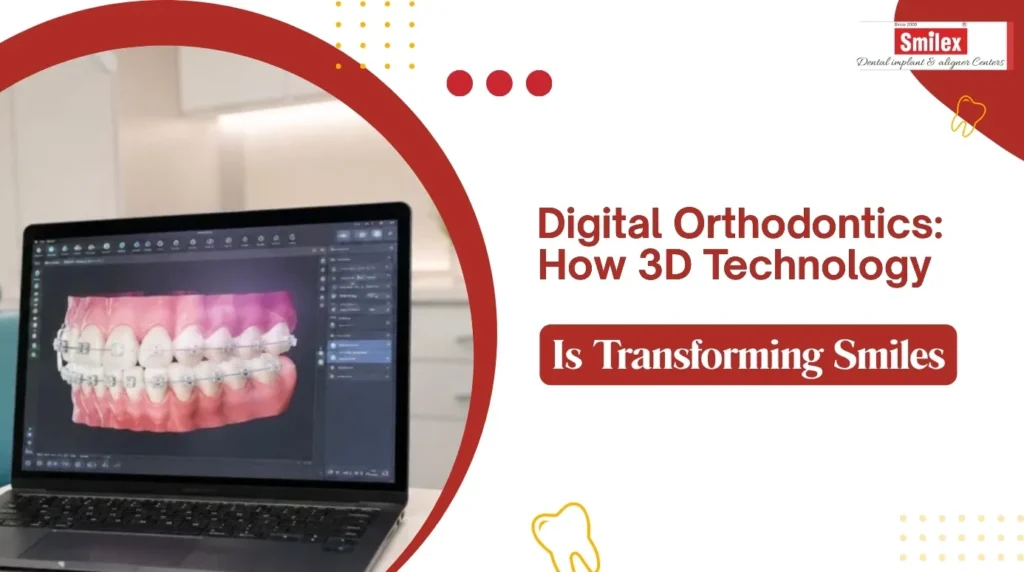
Digital Orthodontics is transforming modern smile correction by combining advanced 3D technology, digital scanning, computer-assisted treatment planning, and virtual smile simulations. Instead of relying only on traditional dental impressions and physical models, orthodontists can now create detailed 3D images of a patient’s teeth and use them to develop a more personalized treatment plan. At Smilex Dental Implant & Aligner Centers, digital technology can help patients understand their orthodontic needs, visualize potential treatment outcomes, and monitor progress throughout their smile journey. From 3D teeth scanning and digital smile planning to clear aligners and modern braces, these technologies are making orthodontic treatment more precise, comfortable, and patient-friendly.
Digital Orthodontics A New Era of Smile Transformation
Orthodontic treatment has evolved significantly with the introduction of advanced digital technology. Today, Digital Orthodontics combines 3D scanning, computer-aided treatment planning, digital imaging, and virtual simulations to make smile correction more precise, predictable, and convenient.At Smilex Dental Implant & Aligner Centers, modern digital technology helps orthodontic specialists understand a patient\’s teeth and bite in greater detail before treatment begins. From 3D teeth scanning to customized clear aligners, digital tools can improve treatment planning and provide patients with a clearer understanding of their expected smile transformation.
What Is Digital Orthodontics?
Digital Orthodontics refers to the use of advanced digital technologies throughout the orthodontic treatment process. Instead of relying only on traditional impressions, photographs, and physical models, orthodontists can use digital scans and 3D imaging to create a detailed virtual representation of a patient\’s teeth.
This technology can support:
- 3D dental scanning
- Digital orthodontic treatment planning
- Virtual smile simulations
- Computer-assisted aligner planning
- Digital bite analysis
- Treatment progress monitoring
- Customized orthodontic appliances
The result is a more technology-driven approach to orthodontic treatment, helping specialists plan tooth movement according to each patient\’s individual dental needs.
How 3D Technology Works in Orthodontic Treatment
One of the most important developments in modern orthodontics is 3D teeth scanning. An intraoral scanner can capture detailed digital images of the teeth and surrounding structures without requiring traditional impression materials.The digital scan can then be converted into a three-dimensional model. Orthodontists can examine this model from different angles, evaluate tooth positions, and develop a customized treatment plan.For patients considering clear aligners, digital scanning can also help create a virtual representation of how the teeth may move throughout treatment.
Step 1: Digital Scanning
The orthodontist uses an intraoral scanner to capture detailed images of the patient\’s teeth. The process is generally quick and eliminates the need for conventional impression trays in many cases.
Step 2: Digital Treatment Planning
The digital model can be analyzed to identify crowding, spacing, bite concerns, and tooth positioning. The orthodontist can then develop a personalized treatment approach.
Step 3: Virtual Smile Simulation
Digital software may allow patients to see a projected treatment outcome. This can make it easier to understand the planned tooth movements and overall treatment strategy.
Step 4: Customized Treatment
Based on the digital plan, customized aligners or other orthodontic appliances can be produced according to the patient\’s requirements.
Step 5: Progress Monitoring
During follow-up appointments, the orthodontist can compare the patient\’s current tooth position with the planned treatment progression and make adjustments when required.
Benefits of 3D Orthodontics
The growing popularity of 3D orthodontics is largely due to the benefits it can offer patients and orthodontic professionals.
1. More Detailed Treatment Planning
Digital models provide orthodontists with a detailed view of tooth positions. This can support more precise treatment planning compared with relying solely on traditional physical models.
2. Greater Patient Understanding
Many patients find it difficult to visualize how their teeth will move. Digital smile simulations can make treatment plans easier to understand by providing a visual representation.
3. Improved Comfort During Scanning
Traditional dental impressions can feel uncomfortable for some patients. Digital scanning uses a small intraoral scanner to capture the necessary information without conventional impression material.
4. Customized Clear Aligners
Digital orthodontic workflows are particularly useful for clear aligner treatment. The patient\’s digital model can be used to develop a customized sequence of tooth movements.
5. Easier Treatment Monitoring
Digital records can help orthodontists compare treatment progress over time. This can support more informed decisions during follow-up visits.
Digital Orthodontics and Clear Aligners
Clear aligners have become an increasingly popular option for people looking for a discreet way to straighten their teeth. Digital technology plays an important role in the planning and production of these customized appliances.
During clear aligner treatment, digital scans can be used to create a 3D model of the patient\’s teeth. The orthodontist can then plan gradual tooth movements and determine how the aligners should be designed.
For patients considering Invisalign treatment, digital planning can also help explain the expected stages of treatment and provide a better understanding of the overall process.
However, every patient is different. The suitability of clear aligners depends on factors such as the type and severity of the orthodontic problem, oral health, bite relationship, and treatment goals. An orthodontic evaluation is therefore important before choosing a treatment option.
Digital Smile Planning: Making Treatment More Predictable
Another important application of modern technology is digital smile planning. Digital photographs, scans, and imaging can be combined to help orthodontists evaluate facial appearance, tooth proportions, alignment, and smile characteristics.
Instead of looking at individual teeth alone, the orthodontist can consider how the teeth relate to the overall smile.
This patient-focused approach can be especially useful when treatment involves both functional and aesthetic goals.
Digital Orthodontics vs. Traditional Orthodontic Planning
Traditional orthodontics remains an effective treatment approach, but digital technology has changed how many orthodontic treatments are planned and monitored.
With conventional methods, physical impressions and models may be used to assess tooth positions. Digital workflows can replace or complement these methods with detailed 3D models.
The goal is not simply to use technology for its own sake. The purpose of digital orthodontic treatment is to provide orthodontists with better information that can support individualized treatment planning and patient communication.
Who Can Benefit From Digital Orthodontic Treatment?
Digital orthodontic technology can be useful for teenagers and adults requiring different types of orthodontic correction. It may be used for patients with:
- Crowded teeth
- Gaps between teeth
- Mild to moderate alignment problems
- Certain bite problems
- Relapsed orthodontic cases
- Cosmetic smile concerns
The right treatment depends on the individual\’s dental condition. Some patients may benefit from clear aligners, while others may require braces or a combination of orthodontic approaches.
A professional examination is essential to determine the most suitable option.
The Future of 3D Dental Technology
The future of orthodontics is expected to become increasingly digital. Improvements in artificial intelligence, 3D imaging, remote monitoring, and computer-assisted treatment planning may further improve the way orthodontic care is delivered.
Digital workflows can potentially make treatment planning more efficient while providing patients with better access to information about their treatment journey.
At the same time, technology does not replace the experience and clinical judgment of an orthodontist. Advanced software and digital scans are tools that support professional decision-making.
Why Choose Smilex Dental Implant & Aligner Centers?
At Smilex Dental Implant & Aligner Centers, technology is combined with personalized orthodontic care to help patients work toward healthier and more confident smiles.
The clinic focuses on modern orthodontic solutions, including clear aligners and braces, with treatment planning based on each patient\’s individual needs. Digital technology can help the orthodontic team assess the current condition of the teeth, explain treatment options, and monitor progress throughout the smile transformation journey.
If you are considering digital orthodontic treatment, clear aligners, or braces, a consultation can help you understand which approach is appropriate for your teeth and bite.
Final Thoughts
Digital Orthodontics is changing the way modern smile correction is planned, explained, and monitored. With technologies such as 3D scanning, digital smile planning, virtual simulations, and customized treatment workflows, orthodontic care is becoming increasingly personalized and data-driven.
Whether you are considering clear aligners, Invisalign treatment, or traditional braces, digital technology can provide valuable information throughout your treatment journey. The most important step is choosing a qualified orthodontic professional who can combine technology with sound clinical judgment.
For personalized guidance about 3D orthodontics and digital smile treatment, consult the orthodontic team at Smilex Dental Implant & Aligner Centers and discover the possibilities for your smile.
Frequently Asked Questions
1. What is Digital Orthodontics?
Digital Orthodontics uses technologies such as 3D scanning, digital imaging, computer-assisted treatment planning, and virtual simulations to plan and monitor orthodontic treatment.
2. Is 3D scanning better than traditional dental impressions?
Digital scanning can provide detailed 3D models while avoiding conventional impression material. The appropriate method depends on the patient’s situation and the orthodontist\’s clinical requirements.
3. Can 3D technology be used for clear aligners?
Yes. Digital scans and computer-assisted planning are widely used to design customized clear aligner treatment plans.
4. Can Digital Orthodontics predict my final smile?
Digital software can provide a projected treatment simulation, but it should be considered an estimate rather than a guarantee of the final result.
5. Is Digital Orthodontics suitable for everyone?
Digital technology can support many types of orthodontic treatment, but the appropriate treatment depends on the patient\’s teeth, bite, oral health, and specific orthodontic needs.
Call : +91 97654 07660
Address: 3rd Floor, Rahul Capital, Prabhat Road, Erandwane, Pune, Maharashtra 411004