
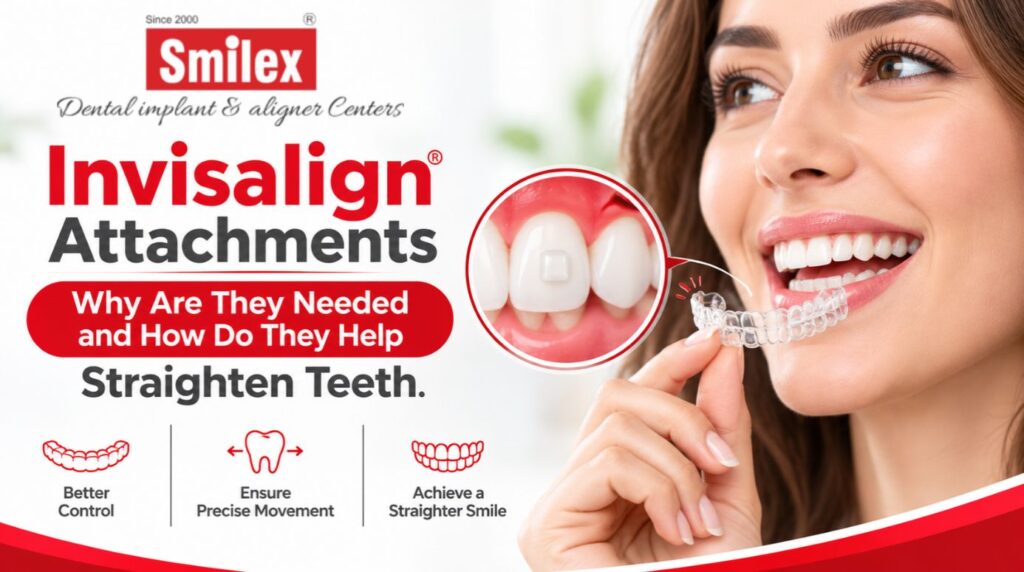
Invisalign attachments are tiny, tooth-colored composite resin forms that are attached to specific teeth to improve the way clear aligners move certain teeth. They provide additional grip and control, helping guide teeth into their planned positions during orthodontic treatment. Although not every patient needs attachments, they can play an important role in correcting rotations, vertical tooth movements and more complex alignment concerns.If you are considering Invisalign Treatment in Pune understanding how attachments work can help you feel more confident about the treatment process. At Smilex International Dental Centre, Dr. Sonali Deshmukh (M.D.S.), Chief Orthodontist and Aligner Specialist, provides orthodontic evaluation and personalised aligner treatment planning.
What Are Invisalign Attachments?
Invisalign attachments are tiny, tooth-coloured composite resin shapes bonded to specific teeth to help guide their movement during treatment. They are carefully bonded to specific tooth surfaces according to the orthodontist’s treatment plan.Unlike traditional braces brackets, these attachments are not connected by wires. Instead, they work together with removable Invisalign aligners.Their main purpose is to give the aligners additional contact points so they can apply controlled forces more effectively.
What Are Invisalign Attachments Used for?
- Improving the grip between aligners and teeth.
- Supporting planned tooth rotations.
- Helping move certain teeth up or down.
- Improving control over complex tooth movements.
- Supporting accurate aligner positioning.
These small additions can make a difference in how effectively aligners guide teeth throughout treatment.
Why Are Attachments Needed for Invisalign Treatment?
Clear aligners work by applying gentle, controlled pressure to gradually reposition teeth. Some tooth movements may require additional support beyond what clear aligners can provide on their own.
This is where Invisalign Attachments become useful.
Your orthodontist may recommend attachments to:
- Rotate teeth: Help turn teeth that are twisted or positioned incorrectly.
- Move teeth vertically: Support extrusion (moving a tooth outward) or intrusion (moving it inward).
- Improve tooth control: Help direct forces more precisely.
- Support complex alignment: Assist with movements that require additional control.
Not everyone needs attachments. Their number, shape and placement depend on individual dental alignment and treatment requirements.
How Do Invisalign Attachments Work?
Invisalign attachments work by creating specially designed contact points between the teeth and aligners.The aligners are manufactured with corresponding spaces that fit over these attachments. When the aligners are worn, they engage with the attachments and transfer controlled forces to selected teeth.As patients progress through their customised aligner sets, these forces gradually guide teeth towards their planned positions.In simple terms, attachments help aligners achieve movements that may otherwise be difficult to control.
Types of Tooth Movements Supported by Invisalign Attachments
Depending on the treatment plan, attachments can support different orthodontic movements.
- Tooth rotation: Helping turn teeth into better alignment.
- Extrusion and intrusion: Assisting with vertical tooth movement.
- Root movement and torque: Supporting control over tooth angulation and root positioning.
- Other planned movements: Helping achieve specific alignment and bite corrections.
The orthodontist decides which attachments are required based on the patient’s individual needs.
Are Invisalign Attachments Visible?
Many patients considering Invisalign Aligners in Pune wonder if the attachments will affect the appearance of their smile. These small, tooth-shaded additions are designed to match the natural colour of your teeth, helping them remain discreet while providing the extra grip needed for effective tooth movement.
However, their visibility depends on:
- The size and shape of the attachments.
- The number of attachments required.
- Their position on the teeth.
- Individual tooth colour and lighting.
Although attachments may be visible at close range, the clear aligners themselves remain a discreet orthodontic option.
Does Getting Invisalign Attachments Hurt?
The attachment placement procedure is generally straightforward and does not usually require drilling or injections.Some patients may notice mild pressure or temporary sensitivity after the attachments are placed. A feeling of tightness may also occur when wearing aligners, especially when switching to a new set. This is a normal part of the teeth-straightening process as the aligners gradually guide teeth into their planned positions. Any persistent discomfort should be discussed with your orthodontist.
Invisalign Attachment Placement and Removal Process
The Invisalign Attachment Placement procedure involves several steps:
- Dental examination: The orthodontist evaluates your teeth, bite and alignment requirements.
- Digital treatment planning: A customised treatment plan identifies which teeth need attachments.
- Tooth preparation: Selected teeth are cleaned and prepared for bonding.
- Composite application: Tooth-coloured bonding material and composite resin are applied using a placement template.
- Securing attachments: The material is hardened using a curing light.
- Aligner fitting: The orthodontist checks whether the aligners fit correctly over the attachments.
Invisalign Attachment Removal
Once the required orthodontic movements are completed, attachments are carefully removed using appropriate dental instruments. The remaining composite material is cleaned away and the tooth surface is polished.
Proper removal helps preserve the natural tooth surface.
How to Take Care of Your Invisalign Attachments
Good oral hygiene is important throughout your aligner treatment.
Follow these practical tips:
- Brush twice daily using a soft-bristled toothbrush.
- Floss daily to remove food particles and plaque from between your teeth.
- Clean your aligners as recommended by your orthodontist.
- Always remove your aligners before meals and drinks, except plain water.
- Avoid chewing hard objects or using your teeth as tools to prevent damage.
- Wear aligners for the prescribed duration.
- Attend scheduled orthodontic follow-up appointments.
If an attachment becomes loose or falls off, contact your orthodontist rather than attempting to fix it yourself.
Invisalign Treatment in Pune at Smilex
Smilex International Dental Centre offers Invisalign treatment for patients looking for a discreet approach to teeth straightening in Pune.Located at Prabhat Road, Erandwane, Pune, the centre provides orthodontic evaluation and personalised clear aligner treatment planning.Your treatment is guided by Dr. Sonali Deshmukh – M.D.S., Chief Orthodontist and Aligner Specialist. An orthodontic assessment helps determine whether Invisalign is suitable for your dental condition and whether attachments are necessary to achieve the planned tooth movements.
If you are searching for an Invisalign Specialist in Pune, an individual consultation can help you understand your treatment options, expected movements and aligner requirements.
Conclusion
Invisalign Attachments play an important role in helping clear aligners achieve specific tooth movements. By providing additional grip and control, these small composite resin additions can support tooth rotation, vertical movements and more complex orthodontic corrections.However, attachments are not necessary for every patient. Their requirement depends on individual alignment needs and the orthodontist’s treatment plan.For professional guidance about Invisalign Treatment in Pune, consult Dr. Sonali Deshmukh (M.D.S.), Chief Orthodontist and Aligner Specialist, at Smilex International Dental Centre, Prabhat Road, Erandwane, Pune.
Considering Invisalign Treatment in Pune?
Understand how Invisalign attachments can support your teeth-straightening journey. Book a consultation with Dr. Sonali Deshmukh at Smilex International Dental Centre.
Frequently Asked Questions (FAQs)
1. What are Invisalign attachments and why are they used?
They are small, tooth-coloured composite resin shapes bonded to selected teeth. They help aligners grip teeth and support specific movements during treatment.
2. Are Invisalign attachments necessary for everyone?
No. Some patients can achieve their planned results without attachments. Their requirement depends on the complexity of tooth movements.
3. Do Invisalign attachments hurt when they are placed?
Placement is generally comfortable. Some patients may experience temporary sensitivity or pressure after the procedure.
4. Are Invisalign attachments noticeable when smiling?
They are tooth-coloured and relatively discreet. However, their visibility depends on their size, number and position.
5. How long do Invisalign attachments stay on teeth?
They generally remain in place for the period specified in the orthodontic treatment plan. Some may be removed earlier if treatment requirements change.
6. Can Invisalign attachments fall off?
Yes. Occasionally, an attachment may become loose or fall off. Contact your orthodontist for advice and replacement if required.
7. Can I eat normally with Invisalign attachments?
Yes, but you must remove your aligners before eating. Avoid biting particularly hard foods directly with your teeth if they cause discomfort or risk damaging an attachment.
8. Are Invisalign attachments removed after treatment?
Yes. Once the required treatment stage is complete, the orthodontist removes the attachments and polishes the tooth surfaces.
Find the clinic here: Get direction
Call Now: +91 97654 07660
Address: 3rd Floor, Rahul Capital, Prabhat Road, Erandwane, Pune, Maharashtra 411004
Disclaimer : AI-generated content, reviewed and edited by a Dentist